Since quite a while I was a big advocate for green tea, drinking it since childhood instead of coffee in the morning. Calm boost, less jitter, and (apparent) solid neuropreserving effects kept me at it.
About two years ago I then discovered matcha - green tea where you consume the entire leaf. More L-theanine, more EGCG, basically green tea on steroids - since then part of my daily stack.
While being a great "superfood", there's a critical thing most don't seem to be aware of.
The Heavy Metal Issue
The tea plant (Camellia sinensis) is a hyperaccumulator. It aggressively absorbs heavy metals from the soil - lead, cadmium, arsenic, aluminium - everything you generally don't want to consume.
With regular green tea the issue isn't as present since the leaves only release a fraction of these contaminents into the water - With matcha, one is consuming the entire leaf. Every heavy metal the plant absorbed directly enters the human body.
Upon hearing of extremely elevated aluminium levels in a bunch of Matcha, I dug (a lot) - here's my findings in compressed form.
Origin Doesn't Mean Much
Most (cheap) matcha comes from China - when origin is not specified it's safe to assume the origin is China. Higher priced matcha often originates from Japan - not all Japanese matcha is equal though, especially due to the recent matcha boom lots of new land has been repurposed to be utilized for tea plants - often resulting in suboptimal (contaminated) soil and environment.
Based what I could observe thus far, there's a lot variance for Japanese Matcha. Some have good profiles, many have bad, and some are outright horrible - e.g. 12x the recommended daily aluminium intake per serving. Aluminium exposure is linked to cognitive decline (as a side note, this is one of the reasons why aluminium-free deodorant was actually a big deal). Besides aluminium, many brands also have increased levels of lead, arsen and many more extremely neurotoxic metals in them - important to hence not pick the wrong one.
Buy First Harvest Only
The longer tea plants sit in the soil, the more heavy metals they accumulate. First harvest (so-called ichiban-cha) matcha has had the least time to collect contaminants - more expensive, but absolutely worth it. Cheap matcha is often second or even third harvest - meaning the plants have twice or triple the time to accumulate contaminents.
Critical to only buy first harvest matcha - strongest differentiator in terms of exposure.
Mixtures Aren't Bad
Unless you find a specific plantation that has perfect lab tests, it's often better to buy a mix from different plantations to get a more evened out profile in terms of heavy metals (stacking up disproportional amounts of one heavy metal is considered worse than loading up evenly across the board).
Only Buy Lab Tested Matcha
Only buy matcha that publishes third-party lab results covering all major heavy metals (and optionally pesticides as a plus).
Any even somewhat serious brand is publishing their matcha's numbers - not publishing is only done if the results would deter people from buying the matcha.
Might sound paranoid, but picking the right matcha vs a bad one is the single thing that determines if it helps or actually is a burden in terms of health-benefits.
What Good Looks Like
Here's what a solid matcha looks like (my current daily driver - still looking for ~/kg300mg aluminium):
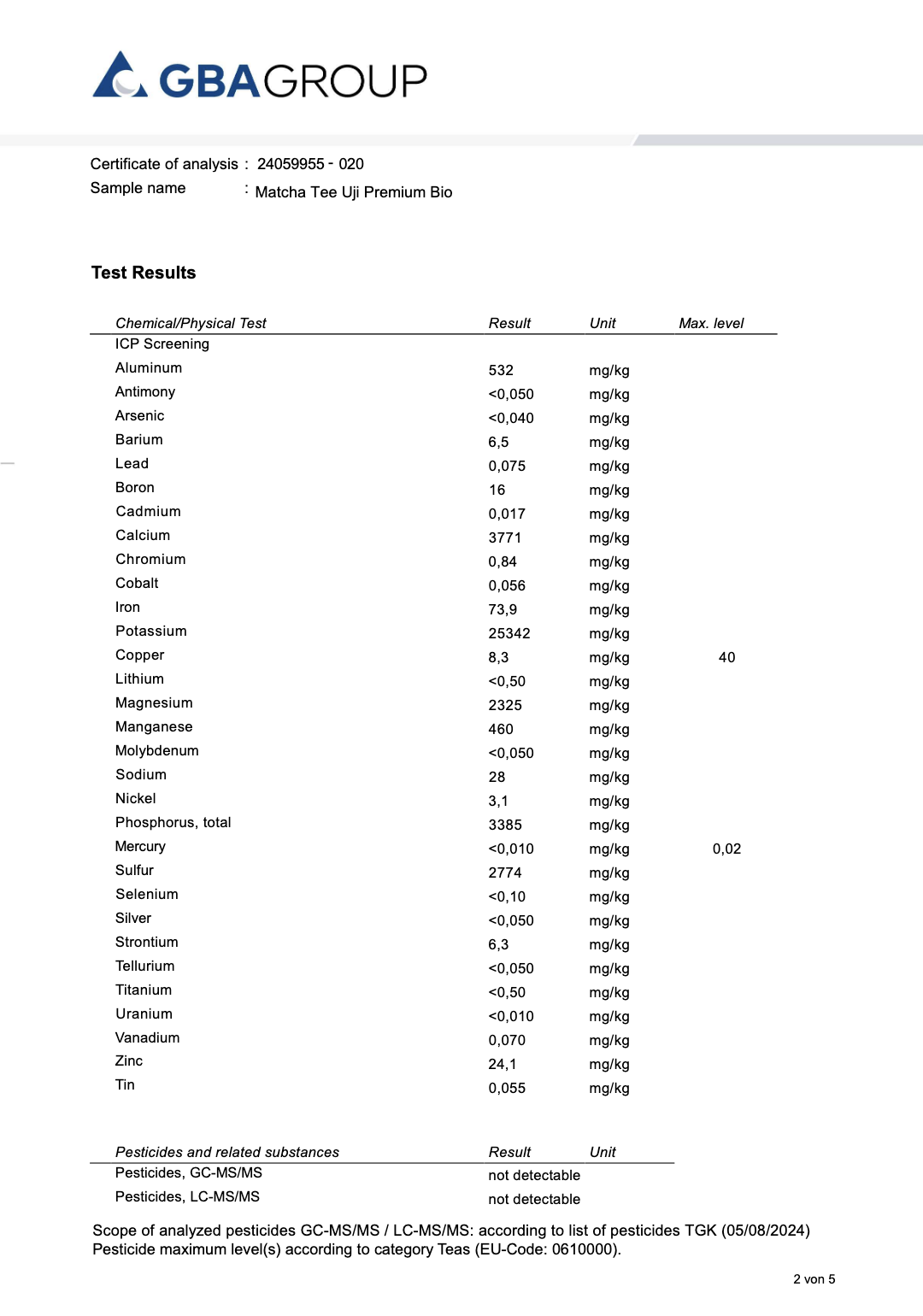
Key numbers: Aluminum at 532 mg/kg (low for matcha), lead at 0.075 mg/kg (negligible), no detectable pesticides.